

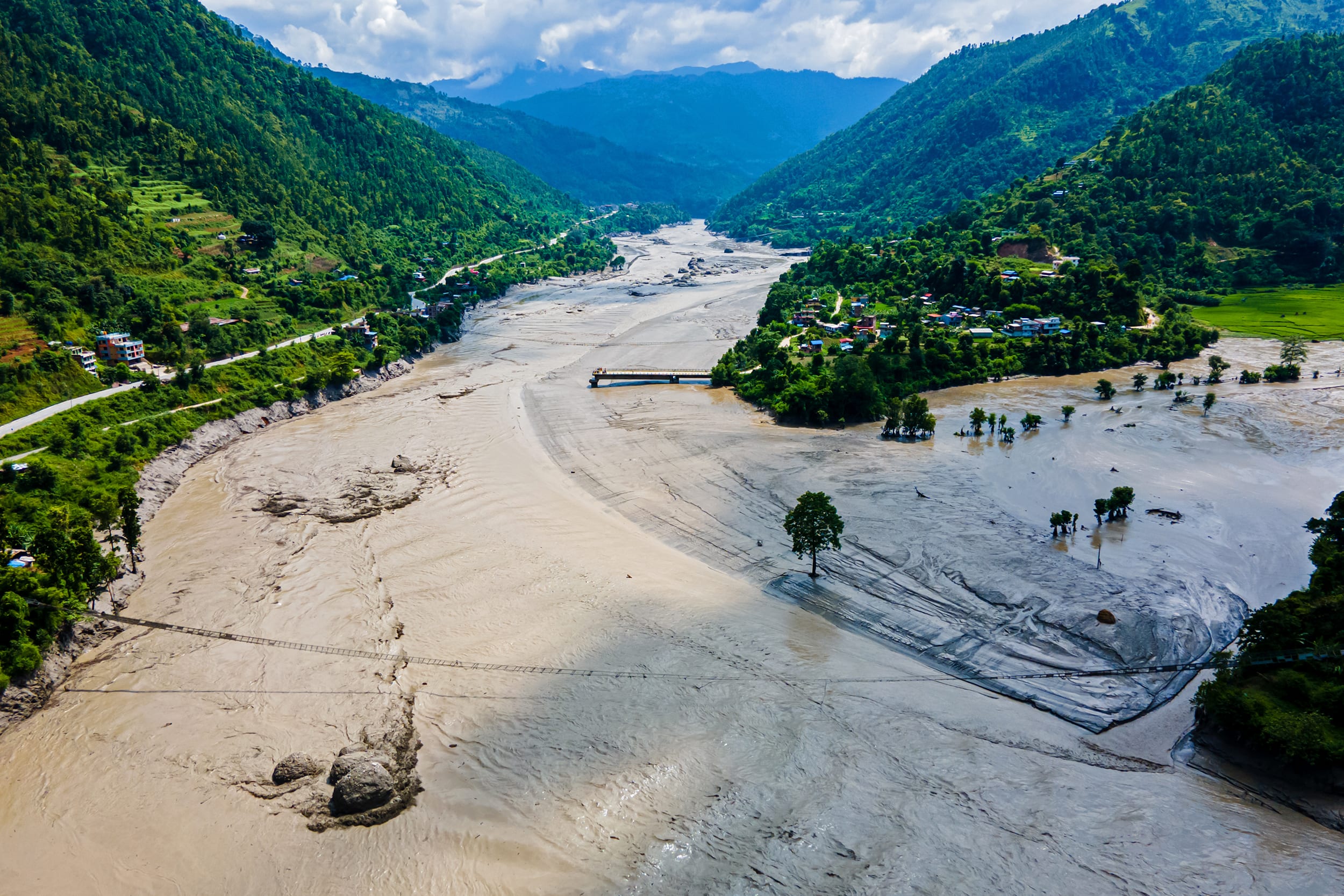
Nepal’s catastrophic flash floods have triggered a huge search-and-rescue operation, international humanitarian response and a fresh warning that another surge could threaten already devastated communities.
The disaster struck on 26 August in the Himalayan border region after a sudden release of water, rock and debris entered the Bhote Koshi river system. The resulting flood swept through Rasuwa and downstream areas, destroying homes, roads, bridges, communications infrastructure and hydropower facilities.
Nepal Police reported that 489 bodies had been recovered by 28 August, while later figures from Nepal’s disaster authority cited by AP put the death toll at 538, with 977 people still missing. The numbers remain fluid as rescue teams continue searching downstream. [SOURCE: Nepal Police/AP]
The crisis also has a direct Irish dimension. Two Irish citizens, Santosh Sahu, 46, and Spandan Sahu, 18, are among those reported missing. Ireland’s Department of Foreign Affairs is monitoring the situation, while the Irish Red Cross has launched an appeal to support emergency relief in Nepal.
Key facts
| Issue | Latest position |
|---|---|
| Disaster | Flash flooding and debris surge in northern Nepal |
| Date | 26 August 2026 |
| Main affected region | Rasuwa and the Bhote Koshi–Trishuli river system |
| Nepal Police casualty update | 489 bodies recovered |
| Later NDRRMA figure reported by AP | 538 deaths |
| Missing | 977 in the NDRRMA figure reported by AP |
| Irish connection | Two Irish citizens reported missing |
| Nepal’s rescue policy | Nepal says domestic security agencies are leading search and rescue |
| International response | UN, Red Cross movement and multiple governments mobilising humanitarian support |
| New danger | Rising water from a landslide-created barrier lake |
Who is helping Nepal after the floods?
The short answer is that Nepal’s own emergency services are leading the search and rescue, while international organisations and governments are providing humanitarian, financial, medical, logistical and consular assistance.
That distinction matters.
Nepal’s Foreign Ministry said on 28 August that the country did not currently require foreign assistance for search-and-rescue operations because its own security agencies were managing the response.
At the same time, countries including the United States, India, China, the United Kingdom, Australia and South Korea have offered or mobilised different forms of assistance.
The United Nations and Red Cross movement are also working on humanitarian relief and assessment.
Nepal’s own rescue operation
Nepal’s security agencies remain at the centre of the emergency response.
Police, army and other emergency personnel have been deployed across affected districts, while helicopters are being used where roads and bridges have been destroyed.
The scale of the terrain is one of the biggest obstacles.
The flood swept away sections of transport infrastructure and left some communities accessible only by air. The destruction of bridges and roads has made it difficult for rescuers to reach areas where people may still be trapped.
Nepal’s authorities are also dealing with a second risk: the possibility of another sudden flood.
Why has rescue work become even more dangerous?
A barrier lake formed by landslide and debris upstream of the affected area has begun overflowing.
Nepal’s National Disaster Risk Reduction and Management Authority issued a fresh warning after increased water mixed with mud and debris was reported in the Bhote Koshi area.
That creates a difficult situation for rescuers.
Teams searching for survivors must now balance the urgency of reaching isolated communities against the risk of being caught by another sudden surge.
Reuters reported that the newly formed lake had grown to more than 2.5 million cubic metres and that rescue operations were temporarily halted in some areas as authorities assessed the threat.
The immediate priority is therefore not simply finding survivors. It is keeping rescuers and residents out of the path of a possible second disaster.
Ireland’s connection to the Nepal floods
For Irish readers, the disaster is more than an international humanitarian story.
Two Irish citizens are among those reported missing following the floods.
RTÉ reported that the missing Irish nationals are Santosh Sahu, aged 46, and Spandan Sahu, aged 18.
Ireland’s Department of Foreign Affairs said it was closely monitoring the situation and working with partners to account for the two Irish citizens.
The Embassy of Ireland in India, which covers Nepal, is involved in providing consular assistance.
Ireland’s official travel advice has also been updated to warn about the flash-flood emergency in Rasuwa and areas near the Nepal-China border.
Irish citizens affected by the emergency are advised to follow instructions from Nepalese authorities and seek assistance through Irish consular channels where necessary.
Is Ireland helping Nepal?
Yes, although Ireland’s role is primarily humanitarian and consular rather than a foreign search-and-rescue deployment.
The Irish Red Cross has launched a dedicated Nepal Flash Flood appeal.
The organisation says Nepal Red Cross teams are already responding on the ground, working with authorities and humanitarian partners.
Its response includes emergency medical assistance, first aid, support for injured people, identification of humanitarian needs and assistance to affected communities.
The Irish Red Cross also says support will be needed beyond the immediate emergency as communities begin recovering from the destruction.
For Irish people who want to contribute directly to the humanitarian response, the Irish Red Cross is currently directing donations through its Nepal Flash Flood appeal.
What is the United Nations doing?
The UN is supporting Nepal’s government-led response through humanitarian coordination, assessment and relief.
UN agencies involved include OCHA, UNICEF, the World Food Programme, UNFPA and WHO.
The UN has released $2.5 million from its Central Emergency Response Fund to help get emergency assistance moving.
Teams are working with the Nepalese government through coordinated response clusters covering areas such as health, shelter and food.
This model is particularly important because the immediate problem is not simply a shortage of foreign rescuers.
It is also a problem of getting food, medical supplies, generators, shelter and other assistance through damaged infrastructure without duplicating efforts.
What are India and China doing?
India and China are central to the regional response because the disaster affected a transboundary river system and areas close to both countries.
India has been coordinating with Nepal and responding to people affected by the disaster, while Chinese authorities have been conducting their own rescue operation in Tibet.
The disaster has also affected nationals from both countries.
China has reported hundreds of people missing in Gyirong County on the Tibetan side of the border.
The geographical location makes the emergency particularly complicated. Roads, bridges and communications links across the mountain region were badly damaged, while the border itself is a strategically sensitive area.
What has the United States offered?
The United States has announced $500,000 in emergency assistance and disaster-response support.
The US is also among the countries that have offered assistance following the disaster.
For Washington and other governments, the response has two dimensions: humanitarian relief for affected communities and assistance to nationals who may still be missing.
What is the UK doing?
The United Kingdom is providing consular support for British nationals affected by the disaster and has offered humanitarian assistance.
British nationals are among the large number of foreign travellers reported missing after the flood.
The UK government has urged people in affected areas to follow local authorities’ instructions and avoid unnecessary travel through the disaster zone.
What is Australia doing?
Australia has also responded to the crisis.
The Australian government has pledged humanitarian funding for affected communities and deployed additional consular support because dozens of Australians are among those reported missing.
The assistance is intended to support humanitarian relief while Australian officials work to establish the welfare of their citizens.
Why is South Korea sending a response team?
South Korea has a particularly direct interest in the disaster because nine South Korean nationals remain unaccounted for.
An 11-member government rapid-response team involving foreign ministry, police and fire officials arrived in Nepal to support efforts concerning the missing South Koreans.
South Korean companies also have workers connected to hydropower development in the affected region.
However, Nepal has indicated that it is not currently accepting foreign search-and-rescue teams as part of its national operation.
South Korea is continuing discussions with Nepal over additional humanitarian assistance.
Why is Nepal not accepting foreign rescue teams?
Nepal says the decision is operational rather than political.
Its Foreign Ministry has said that Nepalese security agencies are capable of managing the search-and-rescue operation and that foreign rescue assistance is not currently required.
That does not mean Nepal has rejected international assistance altogether.
Humanitarian funding, supplies, medical support, international coordination and consular assistance can still play a major role.
This distinction is important because a country can maintain control of its rescue operation while accepting international humanitarian assistance.
How badly has the infrastructure been damaged?
The flood has caused widespread damage to roads, bridges, electricity infrastructure and hydropower facilities.
The affected river system is particularly important because communities and infrastructure are concentrated along valleys and river corridors.
European Copernicus satellite imagery shows how dramatically the river channel and surrounding landscape changed following the flood.
The EU’s emergency mapping service has been activated to assess the flood extent and damage.
The destruction of transport infrastructure also creates a second-order humanitarian problem.
Even when relief supplies are available, getting them to isolated communities becomes much harder when bridges have been swept away and roads are blocked by mud and debris.
Why does the disaster matter beyond Nepal?
The flood is also becoming a warning about the growing risks faced by high-altitude communities.
The event appears to have involved a major collapse of ice, rock and debris in the Himalayan environment. Scientists and authorities are continuing to assess the exact sequence of events.
The wider concern is that climate change is increasing instability in mountain environments, including glacier-related hazards.
For countries across South Asia, the consequences can travel far beyond the location where a glacier, landslide or lake first becomes unstable.
A sudden release of water upstream can rapidly affect communities many kilometres downstream.
What does the crisis mean for Irish travellers?
Irish citizens travelling in Nepal should treat the current situation as an active emergency.
Ireland’s official travel advice says the country should be approached with a high degree of caution and specifically warns about flooding in Rasuwa and the Nepal-China border region.
Travellers should avoid affected areas, stay away from riverbanks and follow instructions from Nepalese authorities.
People travelling through Nepal should also check transport conditions before moving between regions because roads and other infrastructure have been badly affected.
For Irish citizens who are already in Nepal and require consular assistance, the Irish government provides contact details through its official travel advice.
How can people in Ireland help Nepal?
The most direct humanitarian route currently available to Irish members of the public is the Irish Red Cross Nepal Flash Flood appeal.
The organisation says donations will support emergency medical care, first aid, relief for affected families and longer-term recovery.
This is particularly important as the emergency shifts from immediate rescue towards shelter, healthcare, food, sanitation and rebuilding.
The humanitarian needs are likely to continue long after international media attention moves elsewhere.
What happens next?
The immediate priority is finding survivors while keeping rescue teams safe from the possibility of another flood.
The second priority is reaching communities cut off by damaged roads and bridges.
The third is establishing the full scale of the damage.
Only after access improves will authorities be able to produce a more complete picture of casualties, missing people, infrastructure losses and economic damage.
For Ireland, the immediate concern remains the welfare of the two missing Irish citizens and the support available to Irish families.
For the wider international community, the challenge is ensuring that assistance reaches communities quickly without disrupting Nepal’s own command structure.
The disaster has demonstrated how quickly a mountain hazard can become a regional humanitarian emergency.
It has also shown why early-warning systems, satellite monitoring, resilient infrastructure and international disaster coordination are becoming increasingly important in vulnerable mountain regions.
For now, Nepal’s own rescuers remain at the centre of the operation.
But the international response — from the UN and Red Cross to governments across Asia, Europe, North America and Oceania — will become increasingly important as the crisis moves from search and rescue to humanitarian recovery.
KEY TAKEAWAYS
- Nepal’s August 26 flash flood has become one of the country’s most serious recent disasters.
- Nepal Police reported 489 bodies recovered in its latest update, while a later NDRRMA figure reported by AP put the death toll at 538.
- 977 people were still reported missing in the NDRRMA figure cited by AP.
- Two Irish citizens are among those missing.
- Ireland’s Department of Foreign Affairs is monitoring the situation.
- The Irish Red Cross has launched a Nepal flood appeal.
- Nepal says its own security agencies are currently leading search and rescue.
- The UN is coordinating humanitarian assistance and has released $2.5 million from CERF.
- India, China, the US, UK, Australia and South Korea have all offered or mobilised assistance in different forms.
- A newly formed barrier lake has created a risk of another flood.
FAQ SECTION
1. What happened in Nepal?
A catastrophic flash flood struck northern Nepal on 26 August 2026 after a sudden surge of water and debris entered the Bhote Koshi river system, devastating Rasuwa and downstream communities.
2. How many people died in the Nepal floods?
Nepal Police reported 489 bodies recovered in its latest update. A later NDRRMA figure reported by AP put the death toll at 538. The casualty count remains subject to change as searches continue.
3. How many people are missing in Nepal?
The latest NDRRMA figure reported by AP said 977 people remained missing, including more than 500 foreign nationals.
4. Are Irish citizens missing in Nepal?
Yes. Two Irish citizens, Santosh Sahu and Spandan Sahu, have been reported missing. Ireland’s Department of Foreign Affairs is working with partners to establish their whereabouts.
5. Is Ireland helping Nepal?
Yes. Ireland is providing consular support through its Department of Foreign Affairs, while the Irish Red Cross has launched a dedicated Nepal Flash Flood humanitarian appeal.
6. Is Nepal accepting foreign rescue teams?
Nepal’s Foreign Ministry said it currently does not require foreign search-and-rescue assistance because its own security agencies are conducting the operation.
7. Who is helping Nepal after the floods?
Nepal’s emergency services are leading rescue operations. The UN, Red Cross movement, India, China, the United States, United Kingdom, Australia and South Korea have mobilised or offered different forms of humanitarian, financial, consular or emergency assistance.
8. Is another flood possible in Nepal?
Yes. Authorities have warned of another possible flood after a landslide-created barrier lake began overflowing upstream in the affected region.
9. What is the Irish Red Cross doing in Nepal?
The Irish Red Cross says Nepal Red Cross teams are providing emergency medical assistance, first aid, support for injured people and humanitarian assessments alongside local authorities and partners.
10. How can people in Ireland help Nepal?
People in Ireland can support the humanitarian response through the Irish Red Cross Nepal Flash Flood appeal, which is raising funds for emergency medical care, relief and recovery.
11. Is it safe for Irish people to travel to Nepal?
Ireland’s official travel advice currently recommends a high degree of caution and specifically warns about the flood-affected Rasuwa and Nepal-China border areas. Travellers should follow local authorities’ instructions and avoid affected areas.
12. What caused the Nepal flash flood?
The disaster appears to have involved a sudden collapse or release of ice, rock, water and debris in the Himalayan region. Authorities and scientists are continuing to investigate the precise chain of events.
